
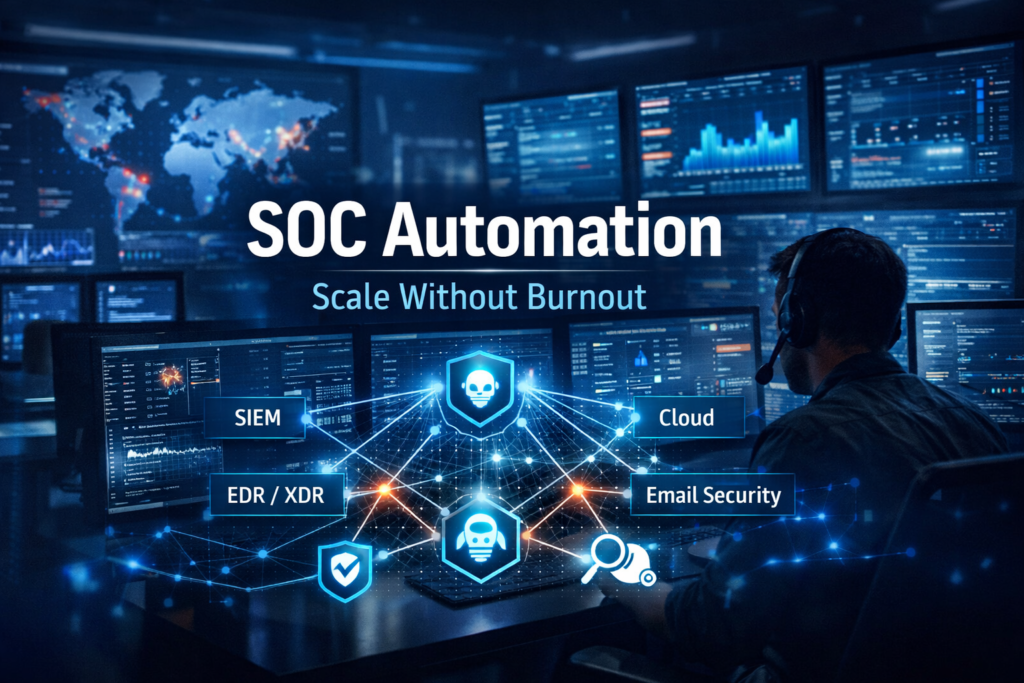
Security teams are not struggling because they lack tools.
They are struggling because too much is still manual.
Most SOCs today already run a SIEM. Many use EDR or XDR. Alerts flow in around the clock. But analysts still spend hours pivoting across dashboards, validating IOCs, enriching alerts, and escalating tickets.
That is not sustainable.
SOC automation is how modern security teams scale without burning out analysts or replacing their existing stack.
This guide explains what SOC automation is, how it works in real SOC environments, practical use cases, and how automation platforms like SOAR make it operational.
What Is SOC Automation?
SOC automation is the use of structured workflows and technology to automate repetitive security operations tasks inside a Security Operations Center.
It typically includes:
- Automated alert triage
- Threat intelligence enrichment
- IOC validation
- Context gathering
- Incident case creation
- Response execution across tools
In simple terms:
SOC automation reduces manual workload and accelerates incident response without removing human oversight.
Why SOC Automation Is Critical in 2026
Security operations have changed.
Alert volumes are increasing.
Attackers are automated.
Hiring experienced SOC analysts is expensive.
Compliance requirements are stricter.
Manual SOC workflows create delays:
- Analysts manually checking IP reputation
- Switching between SIEM, EDR, and cloud consoles
- Writing queries repeatedly
- Escalating incidents inconsistently
SOC automation tools eliminate those repetitive steps and standardize response.
If attackers move in minutes, your SOC cannot respond in hours.
How SOC Automation Works
SOC automation typically runs through an orchestration layer that connects your existing tools.
It does not replace SIEM or XDR. It enhances them.
Here’s what that looks like.
1. Alert Ingestion
Alerts from SIEM, EDR, cloud platforms, email security, or identity tools enter the automation workflow instead of directly landing in an analyst queue.
2. Automated Enrichment
The system automatically gathers context such as:
- IP and domain reputation
- Historical activity
- Asset criticality
- User risk profile
- MITRE ATT&CK mapping
- Threat intelligence matchesWhat used to take 20 to 30 minutes now takes seconds.
3. Risk Based Prioritization
The workflow applies logic and contextual rules to determine:
- False positive
- Low priority
- Needs escalation
- Critical threat
This reduces alert fatigue significantly.
4. Automated Incident Response
Depending on policy and severity, the system can:
- Disable compromised accounts
- Isolate endpoints
- Block malicious IP addresses
- Quarantine phishing emails
- Create ITSM tickets
- Notify response teams
High impact actions can require human approval. Lower risk actions can be fully automated.
5. Case Management and Audit Logging
Every step is documented automatically, creating:
- Structured investigation timelines
- Audit trails
- Compliance ready reports
- Performance metrics for MTTD and MTTR
SOC Automation vs Manual SOC
Manual SOC operations rely heavily on analysts to:
- Correlate logs
- Switch between tools
- Validate indicators
- Write tickets
- Escalate cases
This creates inconsistency and bottlenecks.
SOC automation software introduces:
- Standardized playbooks
- Consistent workflows
- Faster investigations
- Reduced human error
- Scalable 24 by 7 response
Automation supports analysts. It does not replace them.
SOC Automation vs SOAR
SOC automation describes the outcome.
SOAR enables it.
SOAR stands for Security Orchestration, Automation, and Response.
A SOAR platform connects your SIEM, EDR, XDR, cloud, identity, and threat intelligence systems and runs automated playbooks across them.
SIEM collects and analyzes logs.
XDR improves detection visibility.
SOAR automates investigation and response workflows.
If you are evaluating SOC automation platforms, you are effectively evaluating SOAR capabilities.
Real SOC Automation Use Cases
Phishing Incident Response
- Extract IOCs automatically
- Check domain and IP reputation
- Search impacted mailboxes
- Remove malicious emails
- Disable affected credentials
Time saved per incident can be substantial.
Ransomware Containment
- Detect abnormal encryption behavior
- Trigger endpoint isolation
- Block lateral movement indicators
- Alert response teams immediately
Speed reduces impact.
Insider Threat Monitoring
- Detect abnormal login timing
- Identify mass file downloads
- Correlate privilege escalation attempts
- Launch investigation playbooks
Cloud Security Automation
- Monitor IAM policy changes
- Detect exposed storage buckets
- Flag suspicious API behavior
- Trigger automated remediation workflows
Cloud environments require rapid response. Manual review increases exposure.
Benefits of SOC Automation
Reduced False Positives
Automated correlation and contextual analysis reduce noise before escalation.
Faster MTTD and MTTR
Automated enrichment and playbooks accelerate detection and response timelines.
Improved Analyst Productivity
Analysts focus on complex investigations instead of repetitive checks.
Standardized Response
Playbooks ensure incidents are handled consistently across teams and shifts.
Stronger Compliance Posture
Structured documentation supports frameworks like ISO 27001 and SOC 2.
How Securaa Enables SOC Automation
Securaa is a SOAR platform designed to help SOC teams automate and orchestrate security workflows.
Securaa enables organizations to:
- Build customizable response playbooks
- Integrate across SIEM, EDR, XDR, cloud, and identity systems
- Automate enrichment and triage processes
- Reduce alert fatigue through contextual workflows
- Maintain detailed audit trails for compliance
Securaa does not replace your SIEM or XDR. It acts as the automation backbone of your SOC.
For organizations already running a SOC, Securaa helps modernize workflows without replacing existing investments.
What to Look for in a SOC Automation Platform
When evaluating SOC automation tools, consider:
- Depth of integrations
- Playbook flexibility
- Human approval controls
- Built in case management
- Reporting and audit capabilities
- Scalability for enterprise or MSSP environments
Automation should reduce workload without reducing visibility.
Frequently Asked Questions
What is SOC automation?
SOC automation uses structured workflows and orchestration technology to automate repetitive security operations tasks such as alert triage and incident response.
How does SOC automation reduce false positives?
By correlating multiple signals, enriching alerts automatically, and applying contextual risk scoring before escalation.
Is SOC automation the same as SOAR?
SOC automation is the capability. SOAR is the platform technology that enables orchestration and automated response.
Can SOC automation replace analysts?
No. It reduces repetitive work and improves efficiency, but skilled analysts remain essential.
Final Thoughts
Security teams cannot scale manual processes indefinitely.
SOC automation improves speed, consistency, and efficiency while working alongside your existing security stack.
The question is no longer whether to automate.
It is how quickly your SOC can operationalize it.
Still handling alerts manually?
See how automated playbooks reduce triage time and false positives.
