
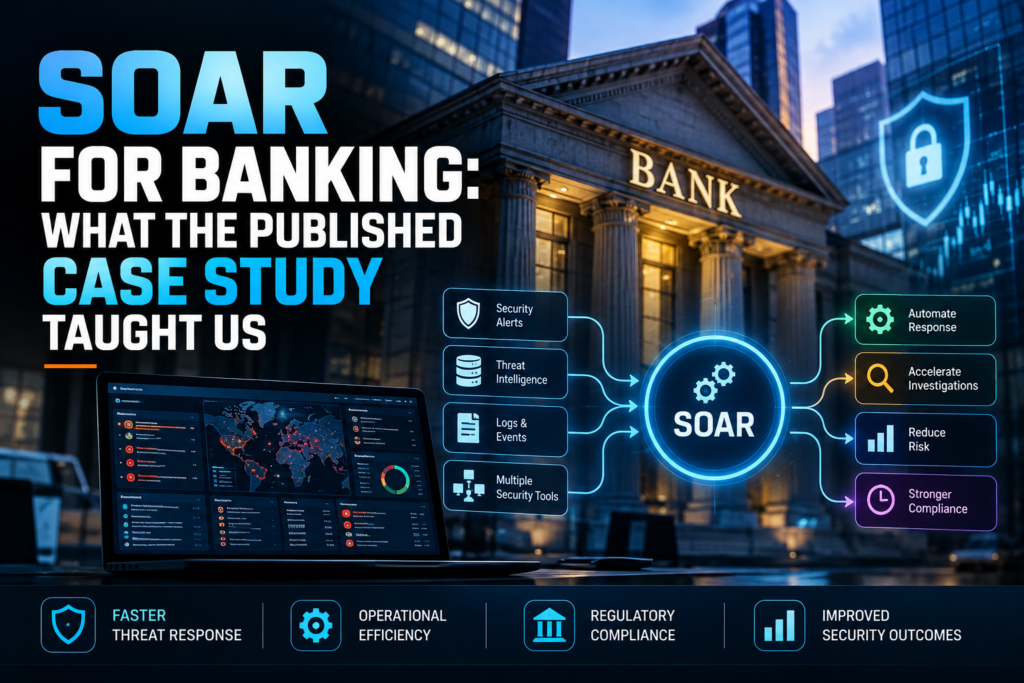
How a mid-tier bank’s SOC went from 4,200 daily alerts and a 6-person team drowning in triage to a structured, automated operation in 90 days.
Banks have a specific security operations problem that makes SOAR not optional but essential. They process millions of transactions daily across multiple channels — branch, ATM, mobile, API. They run legacy core banking systems alongside modern cloud APIs and mobile platforms. They face targeted attacks from financially motivated threat groups and increasingly sophisticated nation-state actors who understand the value of the data they hold.
And they operate under regulatory frameworks — RBI in India, MAS in Singapore, OCC and FFIEC in the US, PSD2 in Europe — that mandate specific incident response timelines, data handling procedures, customer notification requirements, and audit trail standards. A SOAR platform in banking is not a nice-to-have for operational efficiency. It is the infrastructure layer that makes compliance achievable at scale without doubling your headcount every two years.
The Problem: Alert Volume Meets Regulatory Pressure
The bank in this case study ran a 6-person SOC handling 4,200 alerts per day across Splunk (SIEM), CrowdStrike (EDR), Proofpoint (email security), and a proprietary fraud detection system connected to the core banking platform. The team was experienced and competent, but the math was against them.
Analysts spent 70% of their time on repetitive triage — the same enrichment lookups, the same false-positive patterns, the same manual case documentation repeated hundreds of times per shift. MTTR for critical alerts was 4.2 hours, well outside the 2-hour response window the regulator expected for incidents involving customer data. Every audit season, three weeks were consumed assembling evidence packages manually from four different systems because no single platform held the complete case record.
The team was not underperforming. They were under-equipped. The volume exceeded what six people could process manually, and every new regulatory requirement added documentation overhead without adding capacity.
What Changed After SOAR Deployment
The deployment took 90 days from kickoff to full production. Here are the numbers after the first quarter:
- Noise reduction: 78%. Automated triage reduced 4,200 daily alerts to 924 cases requiring human review. The remaining 3,276 were confirmed false positives, auto-closed with full audit trails documenting the enrichment data, the decision logic, and the confidence score.
- Critical MTTR: 4.2 hours to 38 minutes. Enrichment, asset lookup, customer impact assessment, and preliminary containment ran automatically. Analysts received a fully enriched case with a recommended action and the evidence chain, rather than a raw alert with no context.
- Regulatory reporting: automated. Complete, timestamped audit trails on every case — who did what, when, what data was accessed, what actions were taken, and what the outcome was. Quarterly compliance report generation went from three weeks of manual effort to 20 minutes.
- Fraud-security correlation. Account takeover attempts that previously triggered separate alerts in both the fraud detection system and the SIEM became a single enriched case with the full attack chain visible, eliminating duplicate investigations and surfacing cross-system patterns that neither system caught alone.
| The lesson from banking deployments: the highest-value automation is not sophisticated attack investigation. It is the high-volume compliance and triage workload that consumes the team’s capacity and creates regulatory risk when it falls behind. |
Banking-Specific Use Cases
These are the use cases that delivered the most measurable impact in the first 90 days:
- Transaction fraud triage. Fraud alerts enriched with customer profile, device fingerprint, geolocation, transaction velocity, and historical patterns. Auto-close on known-good patterns (same device, same location, within normal velocity). Escalate anomalies with the full context package attached so the fraud analyst does not repeat the enrichment.
- Credential stuffing response. Automated detection-to-response: rate-limit the source IP at the WAF, lock affected accounts with a temporary hold, notify customers via SMS, and create a consolidated incident from what would otherwise be 200+ individual alerts flooding the queue.
- Insider threat monitoring. Privileged access anomalies — unusual database queries, after-hours access to customer data, bulk data exports — enriched with HR data (role, tenure, recent status changes) and routed to the insider threat team with the full behavioral timeline and peer-group comparison.
- Third-party risk alerting. When a core banking vendor appeared in a breach report or threat intelligence feed, the platform automatically checked the environment for matching IOCs, assessed the vendor’s access scope and data exposure, and opened a case with the vendor risk team with a preliminary impact assessment attached.
If your SOC operates in a regulated financial environment and your analysts spend more time assembling audit evidence than investigating threats, the problem is not headcount. It is infrastructure. The right platform does not replace your team — it gives them the capacity to do the work the regulator and the board expect.
