
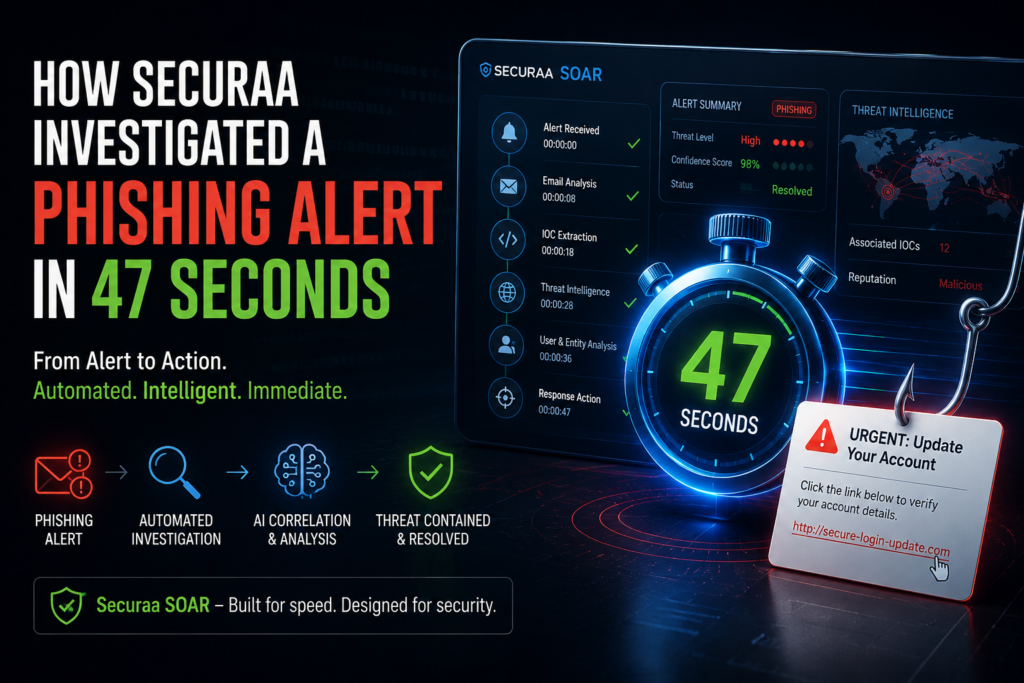
At 10:42 on a Wednesday morning, an employee in accounts payable forwarded an email to the security inbox with a one-line note. This looks off. The email claimed to be from the company’s bank, warned of a hold on an outgoing wire, and asked her to confirm account details through a link. She didn’t click it. She just wasn’t sure, and she asked.
That instinct, forwarding something that looks off instead of clicking it, is exactly what security awareness training is supposed to produce. What happens after she hits forward is usually where the good instinct goes to die, because in most SOCs, that email now sits in a queue behind everything else, waiting for a human to have twenty free minutes to open five tools and figure out if it’s actually dangerous.
This time it didn’t wait. Here’s what happened in the 47 seconds between the email landing in the security inbox and a verdict showing up on an analyst’s screen.
Second 0 to 6: reading the email the way an analyst would
The moment the email hit the inbox, the agent pulled it apart the same way a human analyst opens a suspicious message. Headers first. The sender address looked like the bank at a glance, but the actual return path routed through a domain registered nine days earlier. The display name was spoofed to match the bank exactly, while the underlying address didn’t. Neither fact is unusual on its own. Together, in the first six seconds, they were enough to open the case as a real investigation rather than close it as a false alarm.
Second 6 to 18: checking where the link actually goes
The email contained one link, styled to look like the bank’s login page. Rather than trust the visible text, the agent detonated the link in an isolated sandbox and watched what it actually did. It resolved to a credential harvesting page built to mimic the bank’s portal almost exactly, down to the logo and the color scheme. The page had no relationship to the bank’s real domain. This is the step that used to take an analyst the longest, because sandboxing a link and waiting for the detonation to finish is not instant even when a human is doing everything right. Here it ran in the background while the rest of the investigation kept moving.
Second 18 to 30: checking whether this was already spreading
A phishing email rarely lands in exactly one inbox. The agent searched the mail environment for anything matching the same sender infrastructure, the same subject pattern, the same link domain. Four other employees across two departments had received a close variant of the same email in the previous ninety minutes. None of them had reported it. One had opened the email but not clicked the link, based on read receipts and mail client logs. None of that would have been visible from looking at the original report alone. It only showed up because the agent went looking for the pattern instead of treating the one reported email as the entire incident.
Second 30 to 40: checking the people, not just the email
With four more employees now in the case, the agent checked whether any of their accounts showed signs the credentials had actually been used. This meant looking at recent sign-in activity for anything resembling the harvesting page’s expected next step, a login from a new device or an unfamiliar location shortly after the email arrived. Nothing matched. No account showed a login pattern consistent with stolen credentials being used. That absence mattered as much as anything the agent found, because it’s what separated a phishing attempt that was caught in time from one that had already succeeded.
Second 40 to 47: assembling the case and closing the loop
In the final seconds, the agent pulled everything into one case. The spoofed sender, the sandbox verdict on the link, the four other recipients, the confirmation that no account showed signs of compromise, and a recommended set of actions: quarantine all five emails, block the sending domain, and notify the four employees who hadn’t reported it. The actions requiring account changes were queued for analyst approval rather than executed automatically. The email quarantine and domain block, both low-risk and reversible, went out immediately.
Forty-seven seconds after the original email had been forwarded, an analyst opened a case that already had a verdict, a full timeline, and a plain-language summary of what happened and why, instead of an inbox with one flagged email and a blank investigation to start from scratch.
What a human still had to do
None of this replaced the analyst. It changed what she spent her time on. She reviewed the case, agreed with the reasoning, and made the one call the agent had correctly left to her, whether to force a password reset for the employee who’d opened the email even though no compromise was detected, purely as a precaution. She wrote a two-line note to the security awareness team flagging that the bank-impersonation template was making the rounds again. That took about four minutes. The investigation that used to take the bulk of an analyst’s morning took four minutes of judgment layered on top of forty-seven seconds of work she didn’t have to do herself.
Why 47 seconds and not always 47 seconds
It’s worth being straightforward about what made this fast, because the same investigation doesn’t always resolve this quickly, and pretending otherwise would undersell what actually matters here.
The sandbox detonation was fast because the environment already had capacity available. Under heavier load, that step alone can take longer. The identity check was fast because the case only involved five accounts. An insider case or a wider campaign touching hundreds of accounts takes longer to resolve, because there’s genuinely more to check. And this case resolved cleanly because nothing came back ambiguous. A credential harvesting page that isn’t quite so obvious, or sign-in activity that’s only mildly unusual instead of clearly absent, would have taken longer and involved more analyst judgment along the way, exactly as it should.
What stays constant isn’t the clock. It’s the shape of the investigation. Reading the email the way an analyst would. Checking where the link actually goes instead of trusting it. Looking for the pattern across the whole mail environment instead of treating one report as the whole story. Checking the people, not just the artifact. That sequence is what separates a real investigation from a spoofing check that only confirms what the employee already suspected. The 47 seconds is what happens when that sequence runs on infrastructure built to do it in parallel instead of one tab at a time.
What this took under the hood
None of these seconds happen by accident. The domain-age check and header analysis is one mechanism. The sandbox detonation is a second, running independently of the rest of the case. The search for related emails across the whole mail environment is a third, and it’s the one that turned a single report into a five-person incident. The identity check that looked at sign-in behavior across the affected accounts is a fourth. None of these were bolted together after the fact for this one case. They ran because the platform is built to run them together, every time, on every case that looks like this one.
This is what Securaa is actually built to do. Not one clever detection, but the full sequence, running in parallel, landing on an analyst’s screen as a finished case with its reasoning attached, in the time it takes to read this paragraph. The employee who forwarded that email did exactly what she was trained to do. The only real question was ever whether anything on the other end could keep up with her instinct. This time, something did.
