
There’s a conversation that plays out in a lot of security teams the moment AI comes up. Someone has seen a demo of an AI agent that triages alerts, writes up cases, and clears the queue overnight. They want it. Then the question gets asked that ends the excitement in about four seconds. Where does the data go?
Because for a large number of SOCs, the answer to that question is the whole game. A defense contractor can’t send alert data to a vendor’s cloud. Neither can a bank under strict data-residency rules, a hospital sitting on protected health information, a government agency, or anyone running an air-gapped network by design. The alert stream in these environments is some of the most sensitive data the organization holds. It describes exactly where the weaknesses are. Shipping it to somebody else’s datacenter to be processed is, for these teams, simply not on the table.
So they watch everyone else get AI agents and assume the technology isn’t for them. The pitch they keep hearing is that all the intelligence lives in the cloud, in a model too big to run anywhere but a hyperscaler’s datacenter, and that the price of admission is sending your data out to reach it.
That assumption is worth pulling apart, because it’s mostly wrong. The idea that on-prem means giving up the intelligence rests on a misunderstanding of what intelligence a SOC agent actually needs.
What “intelligence” actually means for a SOC agent
When people talk about how smart the big cloud models are, they’re usually talking about generality. The same model can write a sonnet, debug Rust, explain tax law, and pass a medical exam. That breadth is genuinely impressive, and it’s also almost entirely irrelevant to a SOC.
A SOC agent does a narrow set of things. It reads an alert and decides how likely it is to be real. It gathers context from the tools around it. It recognizes when this alert looks like one the team has seen before. It clusters related events into a case. It writes a clear summary a human can act on. That’s most of the job. None of it requires a model that can also discuss French poetry.
This is the part that gets lost. The thing that makes a general model score well on a broad benchmark is not the thing that makes an agent good at triaging your alerts. Those are different skills. A model can be world-class at the first and unremarkable at the second, and for a SOC only the second one matters.
Once you see that, the question changes. It stops being “can we fit a giant general model inside our walls,” which is hard, and becomes “can we get a smaller model to be excellent at this specific, bounded job,” which is much more achievable. And the answer to that one is yes.
How a smaller model gets there
The mechanism is fine-tuning, and the plain-language version is simple. You take a capable open model, one small enough to run on hardware you own, and you train it further on examples of the exact work you want it to do. Your alerts. Your past cases. The way your senior analysts actually reason about a detection. The specific decisions your SOC makes and why.
What comes out the other side is a model that is narrower than a frontier model and, on your particular task, often sharper. It has effectively been apprenticed to your SOC. It has seen how your team handles the encoded-PowerShell job that runs every Tuesday night, how they treat the vulnerability scanner’s traffic, which alerts they always dismiss and which ones they never do. A giant general model in the cloud has none of that. It’s brilliant in the abstract and a stranger to your environment.
This is the piece of the story that flips the usual assumption on its head. The cloud model’s advantage is breadth. But breadth is not what wins a triage decision. Familiarity with your environment is, and familiarity is exactly the thing a model trained on your data has and a general model in someone else’s datacenter can’t. On the narrow work a SOC agent does, an on-prem model tuned to your SOC isn’t a compromise you accept to satisfy compliance. It can be the better tool on the merits.
It’s worth being honest about the limits here. A fine-tuned on-prem model is not going to match a frontier model at everything, and it doesn’t need to. Ask it to do something far outside the work it was trained for and it will show its size. But a SOC agent is never asked to do that. It’s asked to do the same bounded job, thousands of times a day, in one environment. That’s the job small tuned models are best at.
What you get besides keeping your data
Compliance is the reason most teams start looking at on-prem, but it turns out not to be the only payoff. A few others come along for the ride.
Latency drops. When the model runs next to the data instead of across an internet round-trip to a cloud API, responses come back faster, which matters when an agent is working through tens of thousands of alerts a day. Cost becomes predictable. You’re running your own hardware instead of paying per token, so a busy month doesn’t produce a surprising bill. And you stop being exposed to a vendor’s decisions. When a cloud provider changes a model, deprecates a version, raises a price, or has an outage, on-prem teams don’t feel it. The model on your hardware is the model on your hardware.
There’s also the quiet strategic point. The data your agent learns from is your data, and the improvements it produces stay inside your walls. You’re not handing your incident history to a vendor to help train a model that your competitors will also use. The value compounds inside your own SOC instead of leaking out of it.
What you give up
None of this is free, and a piece that pretended otherwise wouldn’t be worth reading.
You take on operational work. Someone has to stand up the hardware, deploy the model, and keep it running. A cloud API is genuinely less to manage. You also need data to fine-tune on, which means a SOC with two months of history has less to work with than one with two years, the same way every learning system in this space does. And you don’t get the free upgrade. When the cloud model gets better next quarter, cloud users get that for nothing, while an on-prem team has to plan its own model updates.
For a lot of organizations these costs are easily worth paying, because the alternative isn’t a cheaper cloud agent. The alternative is no agent at all, because the data was never allowed to leave in the first place. When that’s the real choice, the operational overhead of on-prem is not a downside. It’s the price of having the capability at all.
What to ask
If you’re evaluating an on-prem AI agent, the claims worth testing aren’t about how smart the model is in general. They’re about whether it can be good at your job, inside your walls, on your terms.
Can the model actually run on hardware you own, fully disconnected from the vendor’s cloud, or does “on-prem” quietly still phone home for the hard parts? Can it be fine-tuned on your own data, and does that data stay with you? When it makes a decision, can your analysts see the reasoning, the same as they’d expect from a cloud agent? And does the vendor treat the tuned model as yours, improving inside your environment, rather than as a channel back to their own training pipeline?
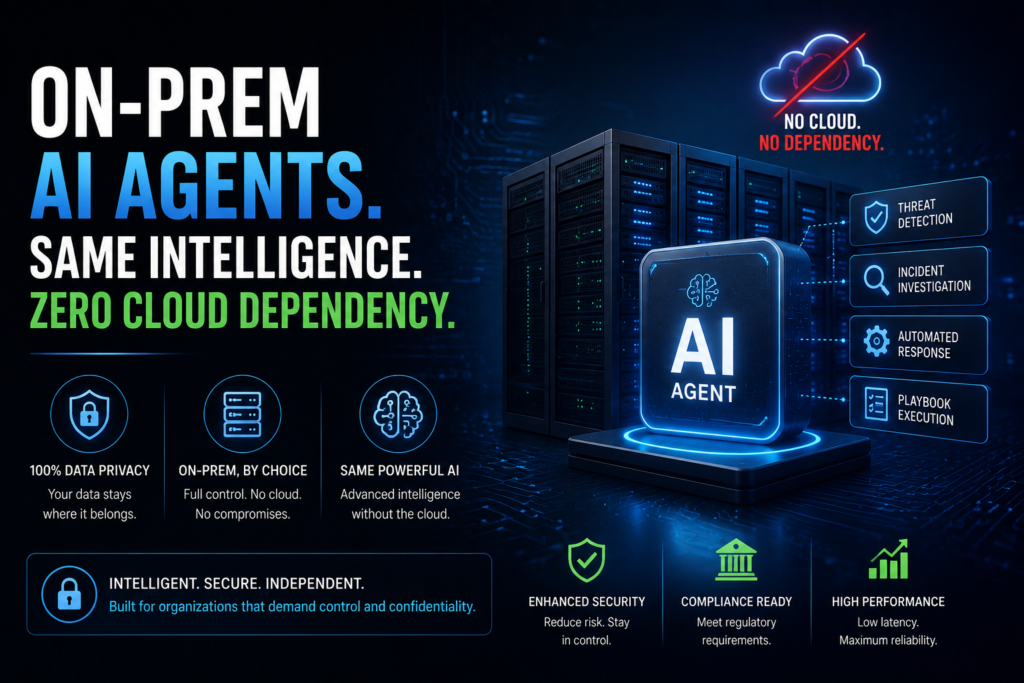
If the answers describe a model that runs entirely on your infrastructure, learns from your data, keeps that data with you, and reasons in a way your analysts can follow, then “same intelligence, zero cloud dependency” isn’t a marketing contradiction. It’s just a smaller model that was taught to be excellent at one job, sitting where your data already lives.
This is the approach we’ve taken with Securaa’s on-prem deployments. Not a stripped-down version of the cloud product, but an agent tuned to the environment it runs in, doing the SOC’s actual work without any of it leaving the building. The teams that assumed AI wasn’t for them were right about one thing. The cloud version isn’t. But the intelligence a SOC agent needs was never the part that had to live in the cloud.
