
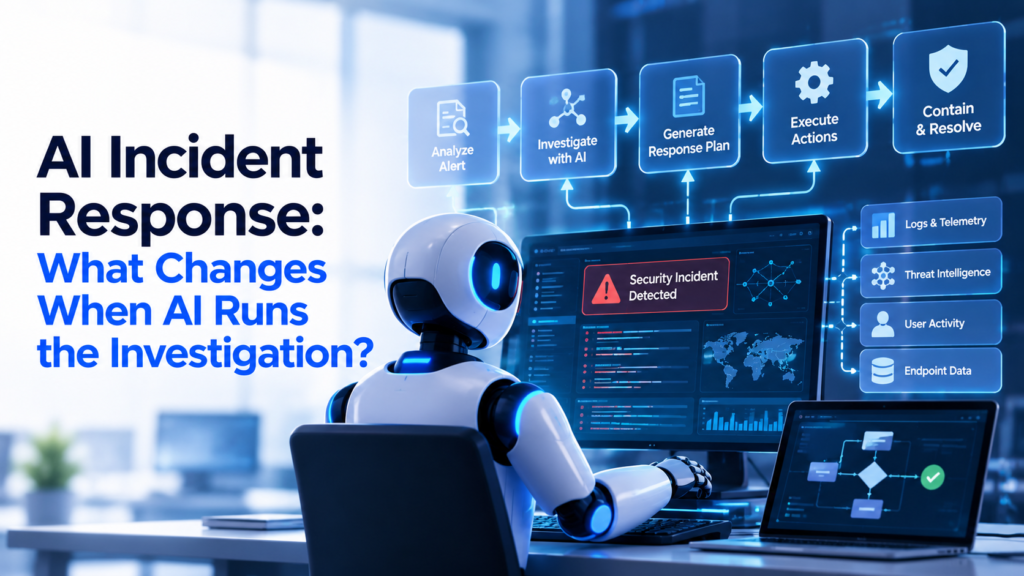
The investigation is where SOC time dies. AI does not just speed it up — it changes what an investigation looks like, who does the thinking, and what gets missed.
A traditional incident investigation follows a predictable arc. An alert fires. An analyst opens it, reads the detection logic, and starts collecting context — asset ownership, user activity, network connections, historical alerts on the same entity. They query three to five tools, copy results into a case note, form a hypothesis, test it against additional data, and decide: escalate, contain, or close. That arc takes 25-45 minutes for a routine alert and several hours for anything complex.
When AI runs the investigation, the arc does not just compress — it fundamentally changes shape. The sequential, tool-by-tool data collection becomes parallel. The hypothesis formation moves from implicit analyst intuition to explicit reasoning chains. The documentation happens as a byproduct of the investigation rather than as a separate task the analyst does afterward. And the coverage changes: an AI investigator checks every alert, not just the ones a human had time to open.
What the AI Actually Does Differently
The difference is not speed alone. Speed is a feature of parallelism — the AI queries six tools simultaneously instead of sequentially. The deeper change is in the investigation method itself:
- Parallel evidence collection. A human analyst queries VirusTotal, waits, queries the SIEM, waits, checks the CMDB, waits. An AI agent issues all enrichment queries in parallel, normalizes the results, and presents a consolidated evidence package. What took 12 minutes of tab-switching becomes 8 seconds of API calls.
- Explicit reasoning chains. A senior analyst’s investigation method lives in their head — pattern recognition built over years. When they close an alert as a false positive, the reasoning is often implicit: ‘I’ve seen this before, it’s the monitoring tool.’ An AI agent writes out every step: ‘Source IP matches the Nagios monitoring server in the CMDB. This server has triggered 47 identical alerts in the past 30 days, all closed as false positives. Confidence: 97% benign.’ That chain is auditable, searchable, and teachable.
- Full-spectrum coverage. A six-person SOC triages maybe 60-70% of daily alerts. The rest are either auto-closed by simple rules or never opened. An AI investigator processes 100% of alerts with the same depth. The 30% that humans never touched is where the missed detections live — the low-severity alerts that were actually the early stages of a sophisticated attack.
- Consistent quality at 3 AM. Human investigation quality degrades with fatigue, shift length, and alert volume. The quality of the 200th alert investigation at the end of a 12-hour shift is not the same as the first. AI investigation quality is constant — the same depth, the same enrichment, the same reasoning rigor regardless of time or volume.
| The shift is not from human to machine. It is from a model where humans do repetitive data collection and machines do nothing, to one where machines handle evidence gathering and pattern matching while humans handle judgment, context, and decisions that carry business risk. |
Where Human Judgment Still Wins
AI investigation is not a replacement for analysts. It is a replacement for the part of their job that does not require their expertise. The parts that do require human judgment are specific and important:
- Business context decisions. Should we isolate this server during a production deployment?
The AI can identify the compromise. The decision to take the server offline during a revenue-critical window requires understanding business impact that no enrichment API provides.
- Novel attack patterns. AI investigation works by comparing current evidence against known patterns. A genuinely novel attack — one that does not match any pattern in the training data or the historical case base — requires human creativity and adversarial thinking to identify.
- Stakeholder communication. Explaining to a VP of Engineering why their team’s credentials were compromised requires human empathy, organizational awareness, and political judgment. AI generates the technical summary. A human delivers the message.
- Escalation judgment. The decision to escalate to executive leadership, invoke the incident response retainer, or notify a regulator carries consequences that extend beyond the technical investigation. These remain human decisions, informed by AI evidence but not delegated to it.
The Investigation Pipeline in Practice
A mature AI investigation pipeline operates in three tiers, each with different levels of autonomy:
- Tier 1 — Fully autonomous. Alert arrives, AI investigates with full enrichment, applies verdict (true positive, false positive, benign activity), executes pre-approved response actions (block external IP, quarantine email), closes with complete documentation. No human sees it unless the verdict is overridden in a later review. This handles 70-80% of alert volume.
- Tier 2 — AI-investigated, human-decided. AI completes the investigation and presents findings with a confidence score and a recommended action. An analyst reviews the recommendation, approves or modifies it, and the platform executes. This handles ambiguous cases, moderate-severity incidents, and anything involving containment actions that carry business risk. Roughly 15-25% of volume.
- Tier 3 — Human-led, AI-assisted. A senior analyst or incident responder leads the investigation. AI provides real-time enrichment, suggests hypotheses, surfaces similar historical cases, and drafts the timeline. The human drives the investigation direction. This covers critical incidents, active compromises, and novel attack patterns. Under 5% of volume but 80% of impact.
The question for every SOC evaluating AI investigation is not whether to adopt it. The question is where to draw the autonomy line for each tier — and whether your platform makes that line visible, adjustable, and auditable. If you cannot see where the AI stops and the human starts, you do not have an AI investigation pipeline. You have a liability.
Frequently Asked Questions
1. What is AI incident response?
AI incident response uses artificial intelligence to help security teams investigate threats, analyze incident data, identify potential risks, and recommend or support response actions.
2. How does AI change security incident investigations?
AI can analyze alerts alongside logs, threat intelligence, endpoint data, and user activity to build a broader picture of an incident. This helps security teams investigate threats with less manual effort.
3. How does AI investigate security alerts?
AI analyzes available incident information, correlates relevant signals, examines potential threat indicators, and helps determine the likely cause and severity of an alert.
4. What is the difference between traditional and AI-driven incident response?
Traditional incident response often relies on predefined rules, playbooks, and manual analyst investigation. AI-driven incident response can analyze incident context and help determine appropriate investigation steps based on the available evidence.
5. Can AI automate incident response?
Yes. AI can automate or recommend tasks such as alert enrichment, evidence gathering, investigation steps, and response actions. The level of automation depends on the platform’s capabilities and configured permissions.
6. What are the benefits of AI incident response?
AI incident response can reduce manual investigation effort, accelerate threat analysis, improve consistency, and help security teams prioritize incidents more effectively.
7. Can AI incident response operate without human intervention?
Some platforms support autonomous investigation and response for defined scenarios. However, high-risk actions may require human approval, depending on the organization’s security policies and the platform’s configured controls.
8. Does AI replace security analysts during incident investigations?
No. AI can handle repetitive investigative tasks and assist with evidence analysis, allowing analysts to focus on complex incidents, validate findings, and oversee critical response decisions.