
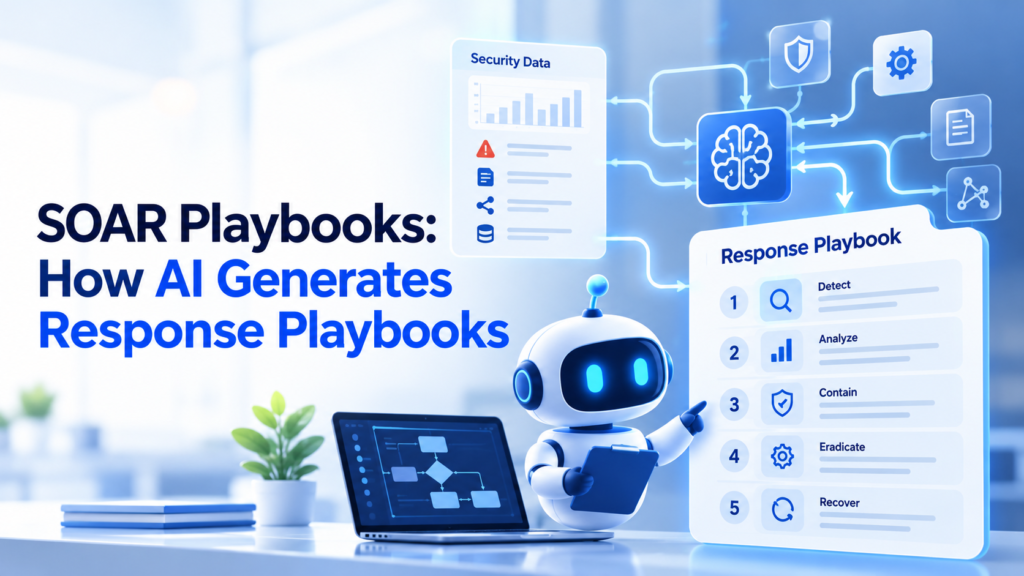
The playbook was the original promise of SOAR. AI changes how they are built, tested, and maintained — but not whether you need them.
The traditional SOAR playbook is a flowchart. An alert arrives, conditions are evaluated, and a predefined sequence of enrichment, decision, and response steps executes. Building one takes a detection engineer, a whiteboard, and anywhere from two days to two weeks depending on how many integrations are involved. Maintaining it takes longer, because the environment changes, the integrations update their APIs, and the threat landscape shifts — and nobody scheduled the maintenance.
This is the core tension every SOAR team faces. The playbook is the most valuable artifact in the SOC — a codified, repeatable response procedure that removes ambiguity and reduces human error under pressure. But the effort required to create and maintain playbooks at scale is the single biggest reason SOAR deployments stall after the first three months.
AI is changing this equation. Not by eliminating playbooks — the structured, auditable response sequence is still the operational backbone — but by changing how they are created, how they adapt, and how quickly a team can go from identifying a gap to having a working response workflow.
How Playbook Generation Actually Works
There are three levels of AI-assisted playbook creation, and the differences matter because vendors regularly conflate them:
- Template selection and customization. The AI matches the alert type to a library of pre-built templates and suggests the best fit. This is useful, but it is pattern matching, not generation. The analyst still customizes the template manually, wiring up integrations,
adjusting thresholds, and handling error conditions. This is where most platforms are today.
- Natural language to workflow. You describe the response in plain English — ‘when a phishing email is reported, extract URLs, check them against VirusTotal, quarantine if malicious, notify the user and their manager’ — and the AI builds the playbook structure: nodes, conditions, integration calls, error handling. This is genuine generation. The output is
a working draft that an engineer reviews and refines rather than building from scratch. Time savings: 60-80% of the initial build effort.
- Adaptive playbooks. The AI modifies a running playbook based on case outcomes. If a particular enrichment step never changes the verdict, the AI suggests removing it. If a new data source becomes available, it suggests adding an enrichment step. If a response action consistently gets overridden by analysts, the AI flags it for review. The playbook evolves without a full rewrite.
| The value of AI-generated playbooks is not that they replace human judgment in designing response workflows. It is that they compress the time from concept to deployable automation from weeks to hours — and keep the automation healthy after deployment. |
What Makes a Good Playbook in 2026
Whether AI-generated or hand-built, the quality bar is the same. A playbook that runs reliably in production meets four criteria:
- Every branch is explicit. The playbook handles the happy path and every failure path. What happens when the enrichment API times out? When the sandbox returns inconclusive? When the asset is in the critical infrastructure group and requires a different escalation chain? Implicit assumptions are the most common source of playbook failures in production.
- Actions are reversible or gated. Containment actions that could cause business impact — isolating a host, disabling an account, blocking a domain — require a human approval gate or an automatic rollback timer. The rollback timer is particularly important: if an analyst approves an isolation at 2 AM and forgets to re-enable, the gate ensures the action is reversed after a defined window.
- Outcomes are tracked. Every execution logs what it did, what the case disposition was, and whether an analyst overrode any step. This data is what makes adaptive playbooks possible
— without it, you are flying blind on playbook effectiveness.
- Versioning exists. You need to know which version was running when a case was handled six months ago, and you need the ability to roll back to a known-good version when an update introduces a regression. Without versioning, you cannot audit and you cannot recover.
The Maintenance Problem AI Actually Solves
Building playbooks is hard. Maintaining them is harder. Most SOCs have somewhere between 30 and 80 playbooks. A quarter of them are stale at any given time — they reference integrations that changed their API, thresholds that no longer reflect the environment, or response actions that the team stopped using months ago. Nobody audits them because nobody has time, and the first sign
of a problem is usually a production failure during an actual incident.
This is where AI delivers the most practical, least controversial value: continuous playbook health monitoring. The AI reviews execution logs, flags playbooks with high failure rates or declining precision, identifies steps that never change the outcome and are wasting execution time, and recommends specific fixes. Think of it as a linter for your response automation — it catches the problems before they cause incidents.
The teams that get the most from SOAR playbooks in 2026 are not the ones with the most playbooks. They are the ones whose playbooks actually work — reliably, every time, at 3 AM when nobody is watching. AI does not change the goal. It makes the goal achievable at scale.
Frequently Asked Questions
1. What are AI-generated SOAR playbooks?
AI-generated SOAR playbooks are automated response workflows created or adapted by AI based on the details and context of a security incident.
2. How does AI generate a SOAR playbook?
AI analyzes incident data, alerts, threat intelligence, logs, and other available context to determine the appropriate response steps and build a recommended playbook.
3. Can AI create SOAR playbooks automatically?
Yes. AI can generate or recommend playbook steps based on an incident’s context, reducing the need for security teams to manually create every workflow.
4. What is the difference between traditional and AI-generated SOAR playbooks?
Traditional SOAR playbooks are usually predefined by security teams, while AI-generated playbooks can adapt their recommended response steps based on the specific incident and available context.
5. What are the benefits of AI-generated SOAR playbooks?
They can help security teams respond faster, reduce manual effort, improve consistency, and adapt response workflows to different incident scenarios.
6. Are AI-generated SOAR playbooks safe to use?
They should operate within defined security controls and approval boundaries. Security teams should be able to review, modify, or approve AI-generated actions before execution when human oversight is required.
7. Can AI-generated SOAR playbooks replace security analysts?
No. They are designed to assist security analysts by automating and recommending response workflows, while analysts can provide oversight for complex or high-risk decisions.
