
How Your SOC Gets Smarter Every Day
Good detections are not written once. They are grown through a continuous cycle of measurement, failure analysis, and refinement that most SOCs never formalize.
Every SOC has that one Sigma rule someone wrote 18 months ago. It fires 300 times a day. Nobody remembers why. Analysts auto-close the alerts because they learned months ago that it generates nothing actionable. But the rule stays active because nobody owns the process of retiring it, and nobody has data to prove it should go.
Meanwhile, a new attack technique is being used in the wild. Your threat intelligence team flagged it three weeks ago. Your detection engineers know they need a rule for it. But they are buried under tuning requests for the 300-a-day rule and a backlog of similar noise problems. The new detection never gets written.
This is the default state of detection engineering in most security operations. Detections accumulate. Some work. Many do not. Nobody has a structured way to tell the difference or systematically improve them. The SOC does not get smarter over time. It just gets busier.
| The difference between a SOC that improves and one that just endures is a feedback loop: every closed case teaches the detection layer something, and that learning gets encoded into better rules, thresholds, and coverage. |
What the Feedback Loop Actually Looks Like
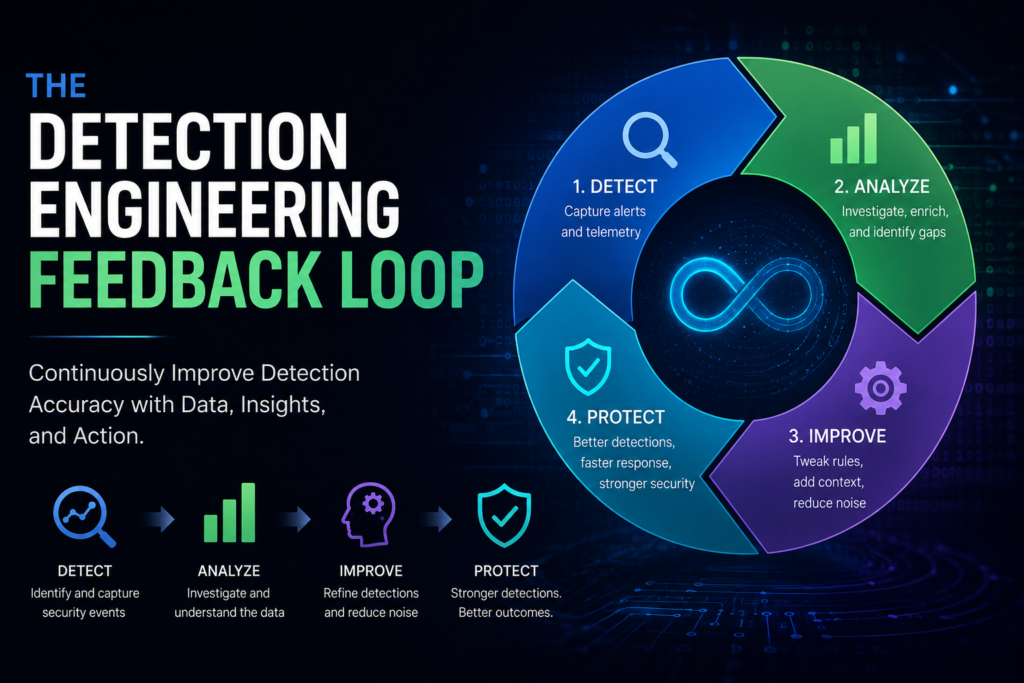
Detection engineering feedback is not a single process. It is a cycle with four stages that repeat continuously. Each stage produces an output that feeds the next one. When the cycle runs well, your detections improve automatically. When any stage breaks, the whole system stagnates.
Stage 1: Case Outcome Capture
Every case that gets closed has a disposition: true positive, false positive, benign true positive, or inconclusive. This disposition is the raw material of the feedback loop. Without it, you have nothing to learn from.
Most SOCs technically capture disposition, but they do it in a free-text field that nobody standardizes and nobody queries. The first fix is structural: make disposition a required, enumerated field tied to the detection rule that generated the case. When an analyst closes Case 1247 as a false positive, you need to know that Case 1247 was generated by rule SIGMA-0042, and that this is the 87th false positive SIGMA-0042 has produced this month.
Stage 2: Detection Scoring
With structured outcome data, you can score every detection rule in your environment on three dimensions:
- Precision. Of all the alerts this rule generated, what percentage were true positives? A rule with 4% precision is generating 96 false alarms for every real threat. That is a tuning candidate or a retirement candidate.
- Coverage. What MITRE ATT&CK; techniques does this rule cover, and how many confirmed incidents involving that technique were caught by this rule versus caught by other means? A rule that covers T1566 (Phishing) but misses 60% of confirmed phishing incidents has a coverage gap.
- Timeliness. How long after the attack activity began did this rule fire? A rule that detects lateral movement 4 hours after the initial access is technically working but operationally too slow to prevent damage.
These three scores give you a prioritized list: which rules to tune first, which to retire, and where you have coverage blind spots that need new detections.
Stage 3: Tuning and Authoring
Armed with scored rules, your detection engineers can work on the right things. The workflow splits into three tracks:
- Tune. Rules with decent coverage but low precision get threshold adjustments, additional conditions, or exclusion lists. The goal is to push precision above 20% without losing coverage. If you cannot get a rule above 20% precision after three tuning cycles, it is a candidate for retirement.
- Retire. Rules that have been firing for 90+ days with zero true positives are generating pure noise. Disable them. Archive the logic in case you need it later. Retiring a bad rule is not a failure. Keeping one running is.
- Author. Coverage gaps identified by the scoring stage get new detections written against them. Prioritize by threat intelligence relevance: if your TIP is seeing active exploitation of a technique you do not cover, that detection goes to the top of the backlog.
Stage 4: Validation and Deployment
New or tuned detections do not go straight to production. They go through a validation cycle:
- Replay testing. Run the updated rule against your last 30 days of telemetry. Did it fire on the same true positives you already confirmed? Did it stop firing on the false positives that triggered the tuning request? If it misses a known TP or still catches known FPs, it goes back to authoring.
- Shadow mode. Deploy the rule in alert-only mode for 48-72 hours. It fires but does not generate cases. Your detection engineer reviews the output manually. If the signal-to-noise ratio meets your threshold, promote it to production.
- Production deployment with monitoring. The rule goes live and enters the scoring cycle. Its precision, coverage, and timeliness are tracked from day one. If precision drops below threshold in the first two weeks, it gets automatically flagged for review.
Then the cycle repeats. Cases generate outcomes. Outcomes score detections. Scores drive tuning. Tuned rules get validated and deployed. The SOC gets measurably smarter with every rotation.
Why Most SOCs Never Build the Loop
The feedback loop is conceptually simple. The reason most teams do not implement it has nothing to do with understanding and everything to do with infrastructure.
The data is not connected.
Case management, detection rules, and alert data live in different systems. Connecting a closed case back to the specific detection rule that generated it requires a data join that most SIEM and SOAR platforms do not make easy. You need a detection ID on every alert, carried through to the case, and preserved through closure. If that chain breaks at any point, you cannot score your rules.
Nobody owns it.
Detection engineering sits in an organizational gap. Analysts work cases. Engineers write rules. Threat intel tracks adversaries. The feedback loop crosses all three functions but belongs to none of them. Without explicit ownership and a recurring meeting cadence (we recommend weekly, 30 minutes), the loop dies from neglect.
The tooling does not support it natively.
Most SIEMs track rule performance at a volume level (how many times did this rule fire) but not at a quality level (how many times was it right). Building quality metrics requires custom dashboards, custom data pipelines, or a SOAR platform that links case outcomes back to rule IDs. This is not
impossible but it is work that nobody budgets for because it does not appear on a compliance checklist.
What Changes When the Loop Runs
Teams that implement the feedback loop consistently report the same set of changes, usually within the first 90 days:
- Alert volume drops 30-50%. Not because threats decrease, but because noisy rules get tuned or retired. The alerts that remain are higher quality. Analyst fatigue drops measurably.
- True positive rate climbs. When you actively track precision per rule, you optimize for it. Teams typically see overall TP rate move from 8-12% to 20-35% within two quarters.
- Coverage gaps become visible. You cannot fix what you cannot see. The scoring stage forces you to map your detection rules to ATT&CK; techniques. The gaps are usually obvious once you look: entire tactic categories with zero coverage.
- Detection engineering becomes proactive. Without the loop, detection engineers spend 80% of their time on reactive tuning requests from analysts. With the loop, tuning is systematic and the engineering team reclaims time to write new detections against emerging threats.
- New hires ramp faster. The scored rule inventory becomes a training resource. New analysts can see which rules are reliable and which are noise. They do not have to learn this through six months of tribal knowledge.
How SOAR Makes the Loop Operationally Viable
The feedback loop is possible without a SOAR platform. But SOAR makes it practical by automating the most labor-intensive parts:
- Automatic rule-to-case linking. A SOAR platform that ingests alerts can preserve the detection rule ID through the entire case lifecycle. When the case closes, the disposition maps back to the rule without manual effort.
- Scheduled scoring. A weekly playbook can query all closed cases, group by detection rule, compute precision and coverage, and publish the results to a dashboard or Slack channel. No human touches the data.
- Replay testing via telemetry queries. SOAR can trigger SIEM searches against historical data to validate tuned rules, then compare outputs against known outcomes automatically.
- Shadow mode orchestration. Deploy rules in alert-only mode via SOAR, route outputs to a review queue instead of the main case pipeline, and promote to production via a single approval action.
The pattern is consistent: the feedback loop is a data problem that SOAR platforms are well-positioned to solve because they already sit at the intersection of alerts, cases, and response actions.
Getting Started This Week
You do not need to build the entire loop at once. Start with the minimum viable feedback cycle and expand from there:
- Today: Add detection rule ID as a required field on every case. If your platform does not support this natively, use a tag or custom field. This is the single most important step because everything else depends on it.
- This week: Standardize your case disposition values. Five options are enough: True Positive, False Positive, Benign True Positive, Duplicate, Inconclusive. Remove the free-text field. Make it an enumerated dropdown.
- This month: Run your first detection scorecard. Pull all closed cases from the last 90 days, group by detection rule, compute precision for each rule. Sort by precision ascending. The bottom 10 rules are your immediate tuning or retirement candidates.
- This quarter: Formalize the loop. Assign an owner. Set a weekly 30-minute review cadence. Build or configure the automated scoring pipeline. Map your rules to ATT&CK; techniques and identify your top three coverage gaps.
| A SOC without a detection feedback loop is a SOC that operates on institutional memory and individual heroics. Both are fragile. The loop replaces fragility with a system that compounds knowledge over time. |
Your detections are not static artifacts. They are living code that either improves with every case your team closes or decays with every threat landscape shift you do not account for. The feedback loop is how you make sure it is the former.
Frequently Asked Questions
What is the detection engineering feedback loop?
It’s a continuous four-stage cycle, case outcome capture, detection scoring, tuning and authoring, and validation and deployment, where every closed case teaches the detection layer something, and that learning gets encoded into better rules, thresholds, and coverage over time.
Why is case disposition capture (Stage 1) so foundational to the loop?
Every closed case needs a clear, structured disposition, such as true positive or false positive, tied back to the specific detection rule that generated it. Without this structured link, an organization has no reliable raw material to learn from, even if analysts are technically recording outcomes in a free-text field somewhere.
What three dimensions does detection scoring (Stage 2) evaluate a rule on?
Precision measures what percentage of a rule’s alerts were true positives, coverage measures how well it catches known incidents involving its associated MITRE ATT&CK technique compared to other detection methods, and timeliness measures how quickly it fires relative to when the actual attack activity began.
What are the three tracks detection engineers work on in the Tuning and Authoring stage?
Tune, adjusting thresholds or adding conditions for rules with decent coverage but low precision; Retire, disabling rules that have fired for 90+ days with zero true positives; and Author, writing new detections to close coverage gaps identified during scoring, prioritized by active threat intelligence relevance.
What validation steps does a new or tuned detection go through before production?
Rules go through replay testing against roughly 30 days of historical telemetry to confirm they still catch known true positives without re-triggering known false positives, then a 48-72 hour shadow mode period where they fire silently for manual review, before finally being promoted to production with ongoing monitoring.
Why do most SOCs never actually build this feedback loop?
The blog cites three recurring barriers: case management, detection rules, and alert data typically live in disconnected systems that make it hard to trace a closed case back to its originating rule; the feedback loop crosses analyst, engineering, and threat intel functions without belonging to any one of them; and most SIEM tooling tracks rule volume but not rule quality.
What measurable improvements do SOCs typically see once the loop is running?
In our experience with teams that have implemented this, alert volume commonly drops 30-50% as noisy rules get tuned or retired, and true positive rates climb from roughly 8-12% to 20-35% within two quarters. Teams also typically see previously invisible coverage gaps become visible, and new analysts ramp up faster using the scored rule inventory as a training resource.